Travel to Singapore
Day 3 Downtown
Leaving Kampong Glam in the late afternoon, we decided to continue on foot towards Marina Bay, following a route that connected several of Singapore's best-known landmarks. Walking southwest, we passed the historic Raffles Hotel, one of the city's most famous colonial buildings. Opened in 1887 by the Armenian Sarkies brothers, the hotel became closely associated with Singapore's role as a major trading port during the British colonial era. The present white neoclassical building dates largely from the end of the nineteenth century and has been carefully restored while preserving its original architectural character. Over the years, it has welcomed numerous writers, politicians, members of royalty, and other notable guests. Although we did not enter the hotel, we paused briefly outside to observe its arcaded façades, verandas, and landscaped entrance before continuing our walk towards the Civic District.
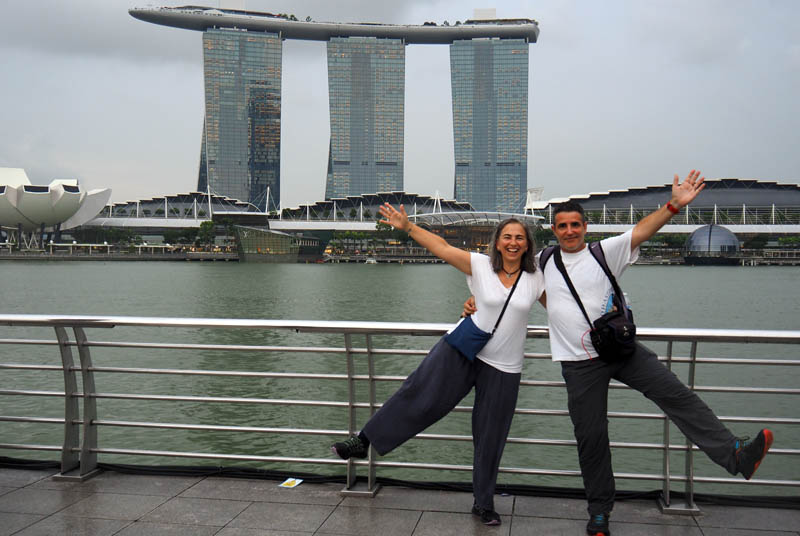
Marina Bay Sands from Jubilee Bridge
From the Raffles Hotel, we crossed part of the Esplanade Park, one of Singapore's oldest public parks, created in the early twentieth century on reclaimed land overlooking the Singapore River. The park contains several monuments commemorating important moments in Singapore's history, including memorials dedicated to those who lost their lives during the Second World War. Wide pedestrian paths connect the park with the surrounding civic buildings, while mature tropical trees provide shade along much of the route. Continuing towards Marina Bay, we reached the elegant Jubilee Bridge, a pedestrian bridge inaugurated in 2015 to commemorate Singapore's fiftieth anniversary of independence. The bridge was specifically designed to improve pedestrian access around the bay and offers uninterrupted views across the waterfront towards the financial district, Marina Bay Sands, and the historic Fullerton area.

Singapore - Merlion
Crossing Jubilee Bridge, we arrived beside the Merlion, Singapore's most recognisable national symbol. Officially unveiled in 1972, the statue depicts a mythical creature with the head of a lion and the body of a fish. The lion recalls the legend that gave Singapore its name, derived from the Sanskrit words Singa Pura, meaning "Lion City," while the fish represents the island's origins as the fishing village of Temasek. Designed by sculptor Lim Nang Seng, the main Merlion stands 8.6 metres tall and continuously projects water into Marina Bay. The adjacent viewing platform allows visitors to photograph both the monument and the surrounding skyline. From this location, we stopped to take several photographs with the Merlion while also observing the Fullerton Hotel, the Singapore River, and the modern skyscrapers forming the city's Central Business District.
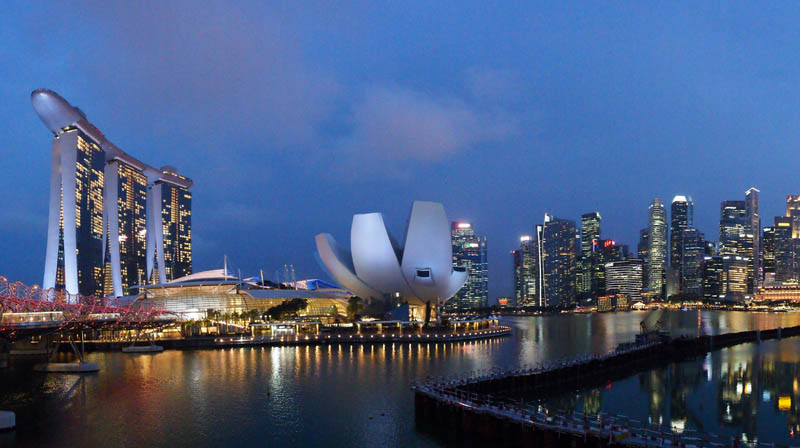
Singapore - Harbour and skyline
After leaving the Merlion, we continued around the left-hand side of Marina Bay, following the pedestrian promenade that circles the waterfront. This route provides continuous views of the bay and links together many of Singapore's principal attractions through landscaped walkways and bridges. As we approached the eastern side of the bay, we crossed the Helix Bridge, one of Singapore's most distinctive pedestrian bridges. Opened in 2010, its stainless-steel structure was inspired by the double-helix shape of human DNA. The bridge extends approximately 280 metres across Marina Bay and incorporates illuminated viewing platforms that project over the water. Information panels along the walkway explain the engineering principles behind the bridge's design and the biological inspiration for its unique structure. Crossing the Helix Bridge also provided changing perspectives of Marina Bay Sands, the Singapore Flyer, and the surrounding skyline.
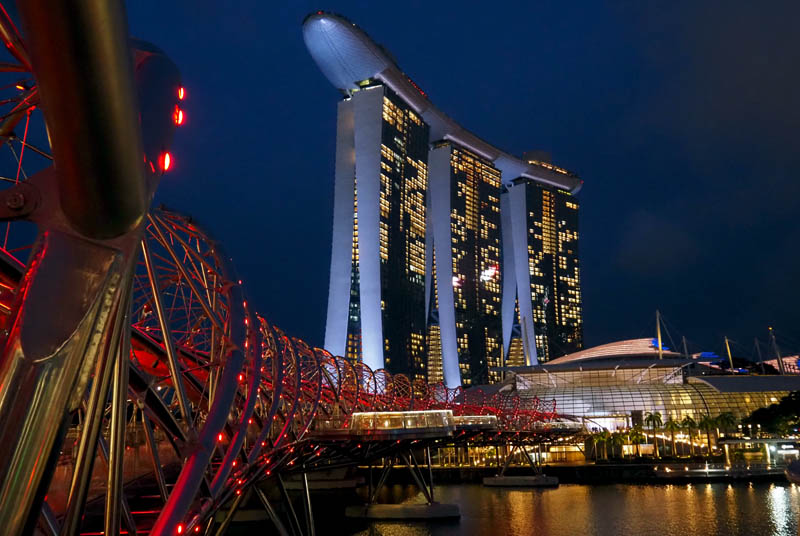
Singapore - Helix Bridge
Immediately after crossing the bridge, we reached the ArtScience Museum, located beside Marina Bay Sands. Opened in 2011 and also designed by architect Moshe Safdie, the museum is immediately recognisable by its lotus-shaped form, consisting of ten projecting "petals" arranged around a central atrium. The building houses a programme of temporary exhibitions combining art, science, technology, design, and digital media, often organised in collaboration with international museums and research institutions. Rainwater collected from the roof is channelled through the central structure and forms part of the museum's sustainable design system. As we walked around the exterior, we observed how the building projects over the waterfront and forms one of the architectural focal points of Marina Bay. We limited our visit to the outside of the museum before continuing along the promenade.
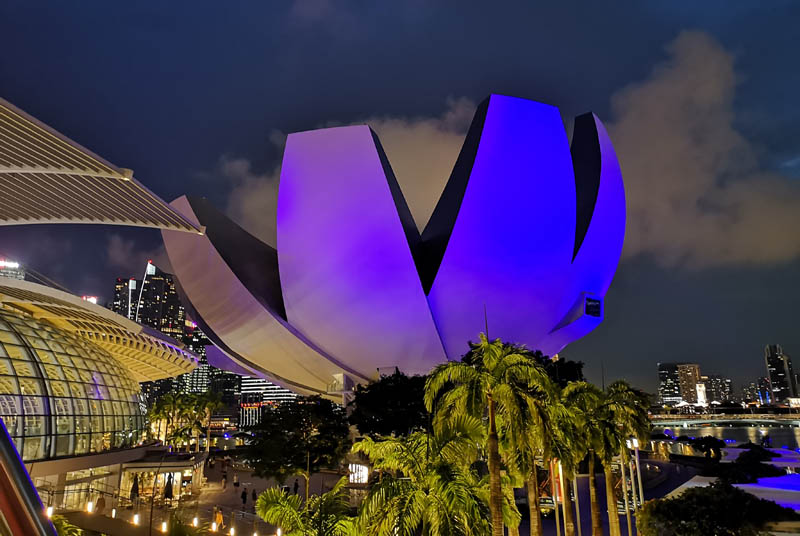
Singapore - ArtScience Museum
From the ArtScience Museum, we followed the pedestrian paths leading towards Gardens by the Bay. The route passes beneath Marina Bay Sands and connects directly with the extensive network of walkways serving the gardens. As daylight faded, the illuminated skyline gradually reflected across Marina Bay, while the surrounding buildings and bridges became progressively lit. We returned to Gardens by the Bay for a second consecutive evening in order to watch its nightly light show once again. Since the gardens themselves would be explored in detail later in our itinerary, we concluded the day there without further explanation, ending another walking route that had linked Kampong Glam, Singapore's colonial district, Marina Bay, and one of the city's best-known waterfront parks